

The melting point of graphite is related to its unique crystal structure and the chemical bonds between carbon atoms. Commonly cited, graphite is often described as having a high-temperature melting point of around 3650℃. However, strictly speaking, graphite does not typically melt directly under normal pressure; instead, it sublimates at temperatures above approximately 3600℃, transforming directly from a solid to a gaseous state. Therefore, graphite does not have a definitive melting point under normal pressure; its sublimation temperature is influenced by factors such as pressure.
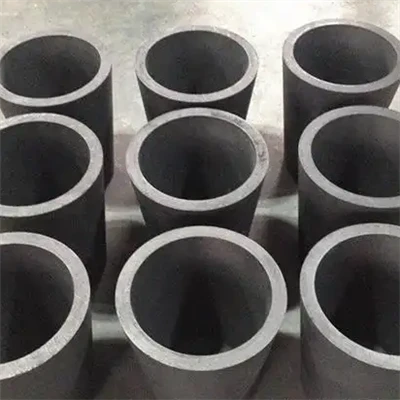
Graphite possesses high-temperature resistance primarily because carbon atoms within the same carbon atom layer are linked by strong covalent bonds, forming a stable hexagonal network structure. This structure requires significant energy to break down, allowing graphite to maintain relative stability at high temperatures. In environments with low oxygen content, such as inert gases or vacuum, graphite can withstand extremely high temperatures, thus it is commonly used in high-temperature crucibles, metallurgical electrodes, refractory materials, and high-temperature industrial equipment. However, when heated in air, graphite will undergo an oxidation reaction with oxygen, and the oxidation rate will increase with the increase of temperature. Therefore, the actual operating temperature depends not only on the high temperature resistance of graphite itself, but also on the surrounding atmosphere, pressure and operating conditions.